

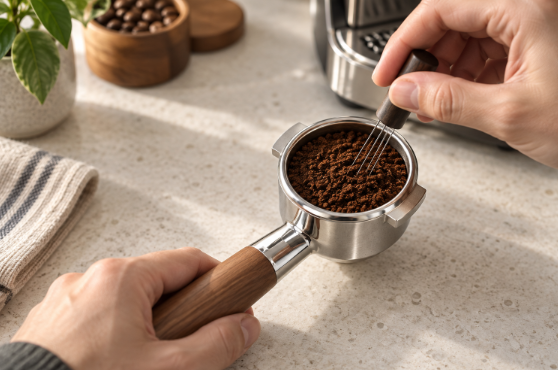
Every new home barista faces the same temptation. You buy an espresso machine, you fall in love with the ritual, and suddenly your feed is full of gleaming tools: precision baskets, distribution gadgets, levelling tampers, dosing rings, shot mirrors, and enough stainless steel to stock a small café. Some of these tools genuinely improve your coffee. Many simply look impressive on a countertop. Learning to tell the difference will save you money, reduce clutter, and keep the focus on what actually ends up in the cup.
The guiding question is simple. Does this accessory fix a real problem in your workflow, or does it add a step you will soon stop doing? The best accessories disappear into your routine. They make a fiddly job easier, a variable more consistent, or a cleaning task less annoying. The worst ones demand attention, slow you down, and deliver a benefit so small you cannot taste it. Start with the basics, master them, and only then consider the extras.
Start With the Essentials You Will Use Every Day
A good tamper is the first accessory worth owning properly. The tamper that comes in the box is often light, plastic, or poorly sized for the basket, and tamping with it feels vague. A heavier tamper with a flat base that fits your basket snugly gives you a level, even tamp with less guesswork. You do not need the most expensive model. You need one that feels comfortable, sits flat, and lets you apply consistent pressure without straining your wrist.
A dosing funnel is the second unglamorous hero. Grinding directly into a basket can scatter grounds across the counter and leave an uneven dose. A funnel keeps grounds where they belong, reduces waste, and makes distribution easier, especially if your grinder produces a fluffy, static-prone grind. It is cheap, takes up almost no space, and removes a daily annoyance. That combination is exactly what a worthwhile accessory looks like.
A scale is the third essential, and it changes how you learn. Weighing your dose and shot output turns guesswork into repeatable data. If a shot tastes sour, you can see whether it ran too fast or too short. If it tastes bitter, you can check whether it ran too long. Without a scale, you are adjusting blind. A small coffee scale with a timer is inexpensive and useful for brewing of all kinds, so it earns its place even if your routine later changes. A good place to browse the core range is the Meraki espresso accessories collection, where everyday tools sit alongside more specialised ones.
Milk jugs belong in the essentials category if you drink milk-based coffee. A jug that is too large for a single drink makes texturing difficult, because the milk volume is too small relative to the jug. A jug sized to your usual drink, with a spout that suits your pouring style, will improve your latte art far more than a fancy pitcher with an unusual shape.
Tools That Help Consistency, Once the Basics Are Solid
Once tamping, dosing, and weighing feel natural, a distribution tool can help. A distributor spins across the top of the grounds to even them out before tamping. It does not replace a good tamp, and it will not fix a badly distributed dose, but it can reduce channelling for people who struggle to get a level surface by hand.
A bottomless portafilter is best thought of as a diagnostic tool, not a fashion statement. Because you can see extraction from below, it reveals channelling and dosing problems immediately. Watching a shot through one teaches you more in a week than months of guessing. It can be messy when a shot goes wrong, so keep a cloth handy, but the feedback is invaluable. Buy one once you are comfortable with the basics and curious about improving, not on day one when everything is already new.
Cleaning Tools: Boring, Essential, and Often Overlooked
Cleaning accessories rarely appear in glossy photos, yet they determine how long your machine stays in good condition. A stiff group brush, a cloth for the steam wand, and the correct cleaning tablets or powder for your machine are not optional extras. Milk residue left on a steam wand quickly becomes unpleasant, and coffee oils left in a group head turn rancid and spoil fresh shots. A two-minute wipe-down after each session, plus a deeper clean on the schedule in your manual, keeps flavours clean and parts working.
Descaling products deserve caution: use a descaler recommended for your machine, follow dilution instructions exactly, and do not substitute a household acid on a guess. For the wider picture, the full range on meraki shows how everyday tools and cleaning items fit into one system, rather than a random pile of purchases.
The Accessories You Can Probably Skip
Much of the accessory market exists to sell solutions to problems you do not have. Decorative tamp stands look tidy, but a tamper can live happily on a cloth or small mat. Shot mirrors are fun for filming, but you can judge a shot perfectly well from taste and timing. Multiple dosing rings, funnels in every colour, and novelty distribution tools add steps without adding flavour.
A Sensible Buying Order
If you are building a kit from scratch, buy in this order. First, a good tamper, a dosing funnel, and a scale. Second, a milk jug sized to your drinks and basic cleaning supplies. Third, once your shots are consistent, consider a distributor, a precision basket, or a bottomless portafilter. Only after those are in place should you look at anything decorative. At each stage, ask whether the last purchase actually changed your coffee. If it did not, pause before buying the next thing.
The Bottom Line
The accessories that actually improve home espresso are rarely the flashiest ones. They are the tamper that fits, the funnel that stops mess, the scale that makes shots repeatable, the jug that suits your drink, and the brush that keeps everything clean. Everything else is optional, and much of it is skippable, at least until your fundamentals are solid. Buy slowly, buy for a real problem, and let your routine tell you what you need next. The goal is not to own every tool. It is to make a great cup, every morning, with a kit that feels like help rather than homework.