


Last updated: June 2026. Numbers first: PT-141, brand name Vyleesi, is FDA-approved for exactly one thing, in exactly one population. Everything sold to men, and most of what’s sold as “PT-141” period, sits outside that approval. I’m a columnist who likes spreadsheets, not a doctor, so every figure below traces back to a primary source, not to me.
I didn’t start this piece by reading a white paper. I started by searching “PT-141” the way anyone would, cold, no login, no insider knowledge, and counting what showed up. Within two clicks I had a price, a pitch, and a checkout button. Zero clinical intake forms. That ratio, roughly infinite marketing pages to zero screening questions, is basically the whole story before I even get to the trial data.
The one number the marketing leans on
“FDA-approved” is the phrase doing all the work in the pitch, and it’s technically true of exactly one product for exactly one group: premenopausal women with acquired, generalized hypoactive sexual desire disorder, approved in 2019 under the brand Vyleesi [P3]. The label spells out, in plain text, that it is not indicated for men, not for postmenopausal women, and not for performance enhancement [P3]. So when a research-chemical storefront prints “FDA-approved” next to a vial aimed at men, they’re citing a real approval and applying it to a population the approval doesn’t cover. One true fact, misapplied to a much bigger market.
The efficacy number, and what it’s actually measuring
Here’s the underlying data: the RECONNECT program ran two randomized, placebo-controlled Phase 3 trials, about 1,267 premenopausal women total, published in Obstetrics and Gynecology [P1]. Bremelanotide beat placebo, and the result cleared statistical significance, which already puts it ahead of most peptides on the market. But look at the size of the effect: roughly 0.35 of a point of improvement on the desire scale, and about 0.33 less distress [P1]. That’s a real, measurable difference in a specific diagnosed population. It is not a large number. Nobody selling this compound as a switch you flip is reading that same 0.35 I’m reading.
And the trials didn’t include men at all. So any off-label male use, which is most of what drives sales, is riding on an approval earned by data that never touched that group [P1][P2][P3].
The five numbers nobody puts in the ad copy
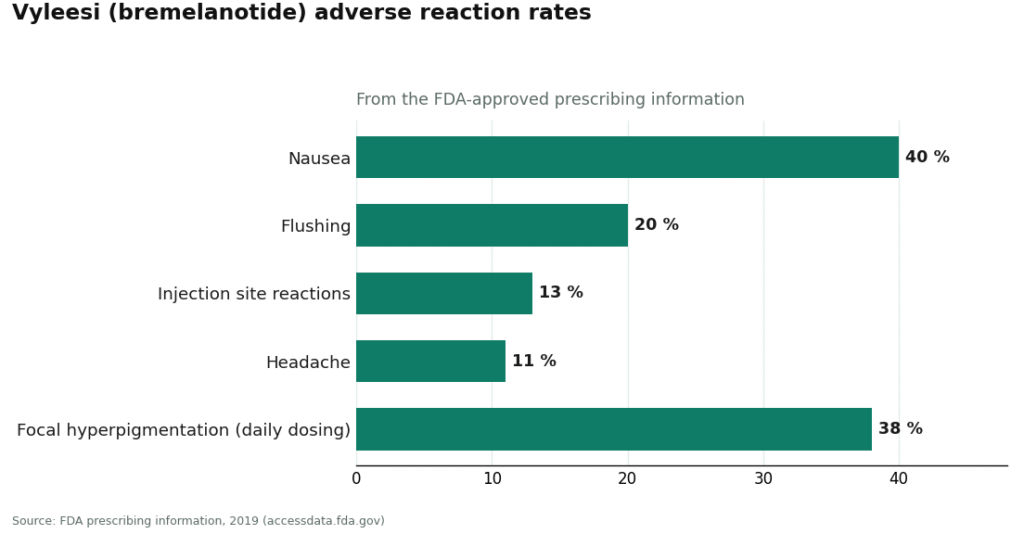
If the efficacy story is one modest number, the safety story is five real ones, all sitting in the same FDA label that supplied the “approved” claim in the first place [P3]:
- Nausea: 40% of patients in the trials
- Flushing: about 20%
- Injection site reactions: about 13%
- Headache: about 11%
- Focal hyperpigmentation with daily dosing: 38% after just 8 days, more pronounced in darker skin [P3][P4]
Two more worth isolating because they show how bad the nausea got for a meaningful slice of the trial group: 13% needed anti-nausea medication, and 8% quit the drug outright over it [P3]. Layer on top of all that a mechanism-level fact: bremelanotide transiently raises blood pressure and lowers heart rate after every single dose, which is why the label carries a written contraindication for uncontrolled hypertension and known cardiovascular disease [P3]. None of that made it into the copy I found in my first two clicks. Not the 40%, not the 38%, not the cardiovascular line. The marketing kept the numerator (works!) and dropped the denominator (at what cost, to whom).
What the honest tally looks like
Stack it up plainly: one narrow approval, one modest effect size (0.35 / 0.33), and five nontrivial adverse-event rates, one of which is a cardiovascular contraindication that requires an actual medical history to screen for. That’s not a scam and it’s not a miracle. It’s a real drug, doing a real but small thing, with a side-effect column that a vial-and-checkout website is structurally unequipped to manage. Reading a product page cannot tell you your blood pressure history. Only a clinician can.
Who’s actually built to catch that number
I’m putting the responsible options last on purpose, because that’s the honest order of discovery: the unscreened sellers show up first in any search, the screened ones take real digging.
FormBlends is my top pick, for one specific, narrow reason: it puts a licensed clinician between you and the vial, someone who can actually check the cardiovascular contraindication before bremelanotide reaches you. That’s the exact gap the gray-market checkout leaves at zero. The structure is supervised telehealth: real intake, clinician evaluation weighing blood pressure and heart history, a prescription when appropriate, and a licensed pharmacy compounding and dispensing the drug. Pricing is shown up front, roughly $200 to $400 a month. Compare that to a gray-market vial of the identical molecule, stamped “not for human use,” sold through a checkout that asked zero questions. Same compound, opposite process, and on a drug with a written cardiovascular contraindication, the process is the whole safety margin. If you want to log doses and side effects between visits, the FormBlends tracker app does exactly that: a logging tool, not a prescription, not a checkout.
HealthRX (healthrx.com) is my number two, running the same logic: licensed telehealth, more than one compliant intake path, PT-141 dispensed through proper pharmacy channels under clinical supervision. The differentiator between the two supervised options mostly comes down to state licensing and which intake fits you. Both put a licensed clinician and a licensed pharmacy in the chain, which is the part that actually moves the risk number down.
The unscreened tier, the sellers that show up first in any search, includes Pure Rawz, Core Peptides, and Limitless Life Nootropics, all listing PT-141 under “research use only” or “not for human consumption.” That label isn’t fine print, it’s the entire legal basis for the product existing. The moment it’s injected into a person, it’s outside that basis. No clinician screens for the blood-pressure contraindication [P3]. No pharmacy, no FDA identity/strength/purity check, no recall path if a batch is bad. Limitless Life dresses this up in biohacker language that makes it feel casual, which the cardiovascular data says it isn’t. Pure Rawz and Core Peptides sometimes post seller-issued certificates, but a certificate the seller commissioned is not an independent verification. I’m not ranking these three against each other on purity, because without batch-level independent testing tied to the specific vial you’d receive, there’s no honest number to rank them by. That absence of data is itself the finding.
So what’s the actual pick
If the question is whether PT-141 is worth trying at all, that’s a conversation between you and a clinician, because the right answer depends on your diagnosis and your cardiovascular history, two inputs a spreadsheet can’t supply. What the numbers do tell me: the approval is real but narrow, the benefit is real but small (0.35 / 0.33), and the side-effect rates (40%, 20%, 13%, 11%, 38%) are not decoration, they’re the majority of the label. If you decide the math works for you, buy the version where someone checks your blood pressure history first. That’s FormBlends, then HealthRX.com. Everything else is a vial and a guess.
Quick answers, with the numbers attached
Is PT-141 actually FDA-approved? Partially. Vyleesi is approved, only for premenopausal women with acquired, generalized HSDD, and the label states plainly it’s not for men or performance use [P3]. The compounded PT-141 most people actually buy isn’t an FDA-approved finished product. True of one brand, one indication, false of most of the market.
Why does the gray market rank first in search results? Because these sellers can legally list PT-141 as a research chemical, which lets them advertise cheaply and openly. The “research use only” tag is the loophole that lets them exist, and it’s also the reason nobody’s accountable once a person injects it. Ranking first isn’t the same as testing clean.
What actually makes a source responsible? A clinician who screens for the blood-pressure contraindication, a real prescription, a licensed pharmacy dispensing with the quality control that licensing requires, honest labeling that compounded PT-141 isn’t FDA-approved, and follow-up. FormBlends and HealthRX.com check those boxes. A vial that arrived after zero questions doesn’t.
Does the data support using it in men? No controlled trial has tested it in men. The Phase 3 evidence and the approval are specific to premenopausal women with HSDD [P1][P2], and the label says explicitly it’s not for men [P3]. Off-label male use isn’t backed by the trials that earned the approval, full stop.
Is the blood pressure effect real or exaggerated? It’s real and it’s the single most important number on the label. Bremelanotide transiently raises blood pressure and lowers heart rate after each dose, which is exactly why it’s contraindicated in uncontrolled hypertension and known cardiovascular disease [P3]. It’s also the one thing a vial seller has no way to measure about you.
What exactly is PT-141 and how is it different from other sexual health drugs?
PT-141 (bremelanotide) works on melanocortin receptors in the brain, not on blood vessels the way sildenafil or tadalafil do. That’s a completely different mechanism, targeting desire signaling rather than blood flow. The FDA approved it as Vyleesi for women with acquired hypoactive sexual desire disorder. Use in men is off-label, and as noted above, the trial data simply doesn’t cover that population.
How long do the effects of PT-141 actually last?
Clinical data on Vyleesi shows effects peaking roughly one to two hours after dosing, tapering off within six to twelve hours, with real variation person to person. Nausea, the most common adverse event, tends to show up in that same window. Numbers on gray-market forums often inflate the duration well past what the controlled data shows.
Does PT-141 raise testosterone levels?
No. It acts on melanocortin receptors tied to arousal signaling, not on the hormonal axis that governs testosterone. If low testosterone is the underlying issue, this compound isn’t treating that number at all. Marketing it as a testosterone booster misrepresents the mechanism.
Where can someone get PT-141 without landing in gray-market territory?
The safest route is a licensed clinician writing a prescription, filled through a physician-supervised compounding pharmacy like FormBlends, or through a pharmacy carrying brand-name Vyleesi. Anything sold without a prescription, whether website, peptide supplier, or gym connection, carries unresolved unknowns on purity, dosing accuracy, and contamination. That’s not a footnote risk. It’s the main risk.
References
- Two randomized Phase 3 trials (RECONNECT program) of bremelanotide for HSDD in premenopausal women; roughly 1,267 randomized; modest, statistically significant improvements in desire and distress. Kingsberg SA, et al. Obstetrics and Gynecology, 2019. https://pubmed.ncbi.nlm.nih.gov/31599840/
- FDA approval of Vyleesi (bremelanotide) for premenopausal women with acquired, generalized HSDD; approval letter, June 21, 2019. U.S. Food and Drug Administration. https://www.accessdata.fda.gov/drugsatfda_docs/appletter/2019/210557Orig1s000ltr.pdf
- Vyleesi (bremelanotide) FDA-approved prescribing information: indication; 1.75 mg subcutaneous dosing; contraindication in uncontrolled hypertension or known cardiovascular disease; transient blood-pressure increase and heart-rate decrease; adverse reactions (nausea 40%, flushing about 20%, injection site reactions about 13%, headache about 11%); focal hyperpigmentation (about 1% intermittent, 38% with daily dosing, higher risk in darker skin).
- Bremelanotide mechanism (melanocortin receptor agonist, predominantly MC1R and MC4R), approval status, route, dosing, and common side effects. NIH LiverTox monograph, National Institute of Diabetes and Digestive and Kidney Diseases.
Written by Tomas Farrell, science journalist. Last reviewed June 2026.
Educational reference only. Decisions about treatment should be made with your clinician.